
Japan’s wholesale used car market continued its remarkable divergence in February 2026: auction supply rose 10.9% month-over-month, yet average winning bids climbed 1.4% to ¥1,824,000 — defying the normal supply-price relationship. This report breaks down the auction data behind six of the most actively exported Japanese vehicles.
Data source: USS (Used car System Solutions) auction results for February 2026, the latest finalized dataset. All prices are tax-exclusive wholesale auction averages in Japanese yen, with approximate USD equivalents at ¥159/$ (mid-March 2026 rate). New to Japanese auction terminology? See our guide to how Japanese car auctions work.
Market Overview — March 2026
The February 2026 USS auction cycle — the last fully settled data available — showed an unusual combination of rising supply and rising prices. Average weekly listings hit 18,849 units (+10.9% vs January), while the sell-through rate edged up to 70.3% (+0.4 points). The average winning bid rose to ¥1,824,000 (~$11,500), a 1.4% increase despite the higher volume.
Two forces are driving this anomaly. First, Japan’s fiscal year-end (March 31) is triggering aggressive dealer restocking — retail lots need inventory for the spring selling season. Second, the yen remains weak at ¥159/$, keeping Japanese vehicles attractively priced for overseas buyers. Export statistics confirm the demand: Malaysia-bound shipments surged +148.2% month-over-month, while Chile exploded +316.3%, partially offsetting a temporary -47.8% dip in Russia-bound volume.
The net result: export-popular models (Land Cruisers, Alphard/Vellfire, Hiace, Harrier) are holding firm or appreciating, while domestically-oriented vehicles (kei cars, compacts, sedans, 5-number minivans) continue a slow but steady decline. For context on how auction grades and pricing work, see our reference guide.
Toyota Land Cruiser 300 — Auction Price Trends
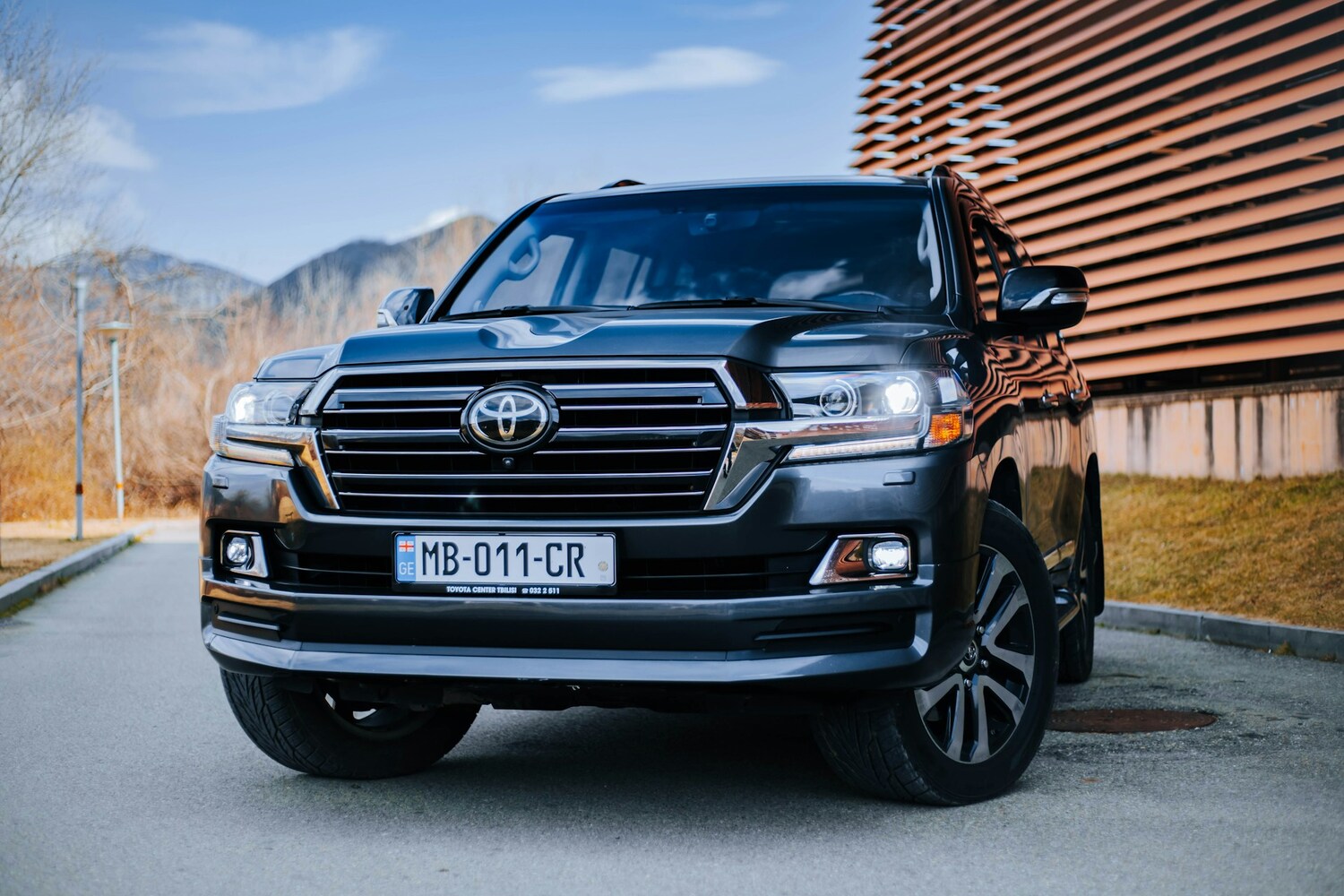
The Land Cruiser 300 remains the single highest-value vehicle in Japanese auctions, with the ZX diesel commanding extraordinary premiums over its sticker price. A key finding: the ZX consistently outperforms the GR Sport in resale, despite GR Sport’s higher MSRP — Middle Eastern buyers strongly prefer the luxury-spec ZX.
$65.2K / $58.9K
$60.4K / $54.5K
$57.3K / $55.3K
$59.3K / $56.4K
$63.1K / $58.7K
$68.7K / —
$54.2K / $52.3K
$59.4K / $52.8K
$59.8K / $55.5K
$62.4K / $60.9K
$74.7K / $69.3K
$76.0K / —
Key Takeaway: The 2026 ZX Diesel achieved ¥12.08M (~$76,000) — a ¥4.48M premium over its ¥7.60M sticker price. Diesel models are outperforming gasoline in newer model years, while gasoline holds an edge on older units (2021) destined for Middle East markets. A distinctive V-shaped price curve exists across model years, driven by destination-specific import regulations. Learn more about how these export regulations affect pricing.
Toyota Land Cruiser 250 — Auction Price Trends
The Prado successor has established itself with strong premiums, particularly in diesel trim. The GX diesel is achieving a remarkable 131% resale-to-MSRP ratio, reflecting its status as the most affordable entry into the Land Cruiser diesel lineup — a fact not lost on export buyers.
Key Takeaway: The diesel-gasoline gap is severe — same-grade VX 2024 models show a ¥1.36M (~$8,600) spread. Gasoline 2024 VX units actually dipped below MSRP (¥5.40M vs ¥5.45M), while every diesel grade trades above sticker. Export buyers overwhelmingly target diesel; gasoline resale carries meaningful risk. Diesel’s export premium is driven by fuel availability in Africa and the Middle East.
Toyota Land Cruiser Prado 150 — Auction Price Trends
The 150-series Prado — produced from 2009 to 2023 — continues to defy depreciation curves. Even 10-year-old units maintain ¥2M+ valuations thanks to relentless African and Southeast Asian demand. The diesel TX-L Package consistently commands a ¥500K–1M premium over gasoline equivalents.
Key Takeaway: Units with moonroof + leather seats + diesel + pearl/black paint are subject to “named bidding” by export agents. Accident-history units retain value unusually well — a 2022 R-grade Prado still fetches ¥3.78M, just ¥220K below Grade 4 clean. Malaysian import regulations (5-year tax exemption) create an urgent deadline: 2020-registered Prados lose their duty-free window at year-end 2025.
Toyota Alphard & Vellfire — Auction Price Trends
Japan’s flagship luxury minivan twins continue to command the strongest residual values in the segment. The 40-series (current) trades above MSRP, while 30-series units benefit from sustained Malaysian and Middle Eastern demand. Vellfire’s Z Premier turbo — a model with no Alphard equivalent — shows an extreme ¥1.06M spread between Grade 5 and Grade 4.
Key Takeaway: The 2018 minor change (3-beam LED headlights, TSS 2nd-gen) creates a sharp ¥800K+ cliff between pre-MC and post-MC 30-series units — export buyers strongly prefer the facelift. Current 40-series Vellfire trades at a premium over Alphard due to the exclusive Z Premier turbo grade. Both models face the same Malaysian 5-year import deadline: 2020-registered units expire at end of 2025.
Toyota Hiace 200-Series — Auction Price Trends
The Hiace is perhaps the single most export-dependent vehicle in Japanese auctions. Units 10+ years old with 100,000+ km still command over ¥1M — a depreciation profile that simply does not exist for any other commercial vehicle. The 4WD diesel configuration carries a ¥500K–950K premium over 2WD gasoline.
Key Takeaway: The “ideal export spec” — diesel × 4WD × S-GL Dark Prime II — can exceed ¥4.1M for 2026 models. Even pre-2012 units at Grade 4 fetch ¥1.55M ($9,700), making Hiace the only vehicle where “10+ years old and 200,000 km” is not a deal-breaker. Wagon variants (Grand Cabin) trade ¥300K–500K above equivalent-year Van GL models.
Toyota Harrier — Auction Price Trends
The Harrier occupies a unique position: strong both domestically and in export markets, with a noteworthy “gasoline premium” in overseas trade. The 60-series (prior generation) shows remarkable resilience — 2020-model 60-series units trade just ¥290K below same-year 80-series debut units.
Key Takeaway: Harrier is one of the few models where gasoline outperforms hybrid in export resale by ¥100K–200K — the reverse of domestic new-car pricing. The panoramic moonroof (80-series) and standard sunroof (60-series) are critical export requirements; units without these features lose ¥300K+ in overseas valuation. With a rumored full model change in late 2026–2027, current 80-series owners should consider selling before any official announcement.
Export Market Trends & Regulatory Updates
Destination demand shifts: UAE held the #1 position in February with 17,755 units (+9.4% MoM). The Russia corridor contracted sharply (-47.8%), but this was more than offset by explosive growth from Malaysia (+148.2% to 8,105 units) and Chile (+316.3% to 7,169 units). Tanzania remained stable at 8,542 units. The diversification of export destinations beyond traditional Russia/Africa corridors is a structural trend worth monitoring.
Regulatory watch: Malaysia’s 5-year import duty exemption continues to be the most price-sensitive regulation in the market. For calendar year 2026, this means 2020-registered vehicles face their final months of eligibility. Sellers of 2020-registered Alphards, Vellfires, Harriers, and Prados should act before year-end to capture the export premium. Several African nations are also considering tighter age restrictions on imported vehicles, though no concrete legislation has been enacted this quarter.
FX impact: At ¥159/$, the yen remains in a range that keeps Japanese wholesale prices attractive for overseas buyers. For reference, a ¥3,000,000 auction unit translates to roughly $18,900 FOB — well below comparable vehicles sourced from South Korea or European markets. Any sustained yen strengthening below ¥150/$ would likely dampen export demand and put downward pressure on auction prices for export-dependent models.
Next month outlook: March is historically the strongest auction month of the year due to fiscal year-end restocking. We expect sell-through rates above 70% and further price firmness for export-popular models. April typically brings a brief softening as the new fiscal year begins.
About This Report
This report is published monthly by Used Car Market Log (usedcar-market-log.com), a Japanese media outlet specializing in wholesale auction data analysis. All prices are derived from USS (Used car System Solutions) auction transaction records — the same data source used by professional Japanese dealers for purchasing decisions. For a full explanation of grades, FOB pricing, and export access channels, see our How Japanese Car Auctions Work guide.
Monthly Report Archive
This is the inaugural issue of our English monthly report series. Future monthly reports will be linked here as the archive grows.
- March 2026 (this issue) — February auction data
Browse all English content: English Top Page | Report Archive | Auction Guide